Friday, 13 November 2015

Getting a bird's eye view in Shinjuku

How do you get the sense of Tokyo's immensity? For me to let my parents feel the sheer size of Tokyo, I took them to the Tokyo metropolitan government building in Shinjuku. The view from its observatories on the 45th floor is truly breathtaking, and is free!

The walk to the building was a challenge as Shinjuku JR station is the largest in Tokyo. Navigating inside the station was tricky, even outside rush hour. ONce out of the tunnels though the walk from the station to the office building offered some view on the surrounding high rises, especially this MODE gakuen cocoon tower.
  

Outside of the building itself was quite interesting and we spent some time there before going up. From outside, the building with the two towers looked like a cathedral. The arena outside and the spaceship structure were quite intimidating and imposing.


 The few flowers here and there did not quite soften the image of the concrete and glass towers. Nonetheless inside was well organized and indicated. There was even a welcome rake inside (Kazari Kumade), to gather all the good fortune from the visitors (aha! crowdsourcing).
 

 The trending topic was the upcoming Tokyo Olympics in 2020 and colourful banners adorned the main hall. Of course being in Japan safety was also observed in the form of information about emergency numbers in case of earthquakes, a frightening call to reality.
And so finally after a bit of queueing we got to the observatory. There are a few stars of the skyline: Sky tree, the cocoon.


But all in all for me the vast sea of concrete jungle extending beyond the horizon was the star.


As we saw a park nearby, among the suffocation of all the concrete, we made our way to the Shinjuku Chuo park which I have never visited before. It was quite pleasant, and used by students to practice plays, music or exercise. 


 I could imagine the park completely full at lunchtime when all the office workers come out of all the hundreds of offices surrounding it. We could only enjoy the peace of it until then.


Thursday, 12 November 2015

A quick visit of Shibuya and an evening stroll in Asakusa

After a slow start due to the early market  trip, we got out to explore two contrasting neighbourhoods: Shibuya first, and then Asakusa.

Taking the Yamanote line brought me memories of my first trip, but also made me so comfortable as I got so used to it from my previous trips. With the JR railway pass, the Yamanote line was the most useful train line as it goes around Tokyo in both ways, covering so much sightseeing I forgot there were other train lines!

So from Ikebukuro station, which neighbourhood deserves a tour in itself, we went to Shibuya to experience the crowded crossing, the loud jingles that surprised my Dad (he probably turned off his hearing aid) and the maze like corridors in the train station that was being modernized.


We visited Tokyu Hands (only 2 floors of it), where my parents got a wooden game I still haven't played, and I got a hair drying band and a few bath salts and small umbrella, we also popped into a puricula store (always wanted to go). It was funny how everyone else in there were teenage girls. Yet there we were.


Those pictures make hilarious souvenirs and highly recommended.


After that tiring loud crowd immersion, we rode the Yamanote line again to Ueno station to walk to Asakusa old alleys and attractions.

It was a long walk, and I regretted not taking the bus or not transferring to  anon JR line. Eventually though we got to the dinner ware street with all the pretty bowls and plates that wanted to get into our full suitcases (why full? no idea).
 

As the sun set we chanced upon a nice view of the new Sky tree.
And as we approached the main Asakusa Senso-ji temple we passed by the cute old shops that gives Asakusa its charms. 
Eventually we saw the pagoda appear and strolled on the shrine ground, even made some incense offering. I must say the night view is prettier than the day view.


 And finally the not to be missed view from the Kaminarimon gate. I like this gate as the kanji character written on the chochin (lantern) is the one for lightening/thunder, which combines the character for rain and rice field.

There is a lot of history surrounding the temple and this area of Tokyo, close to the Sumida river, but it was interesting to witness how history was continued around the river, with the new attraction, Sky Tree, built across the river. This superposition of old and new is what fascinates me in Tokyo and what keeps me coming back. This impression that I was walking through palpable history. I wished back in Madagascar we could cherish history as much and be more grateful of happenstances and not so much constraining superstitions. But it must be also because Japan is a country of abundance and people got something to cherish and pour their hear and feelings into. In comparison people in Madagascar only barely have enough to live, and people's existence is the only proof of their existence. Artifacts such as art, sculptures, buildings only remain but not so celebrated in the collective minds. maybe I should make more efforts to find out about those next time.

As we were changing hotel that day we dragged our luggage to Ikebukuro to the b Ikebukuro and explored the small alleys nearby the station, full of drinking places and restaurants to cater to workers before going home. I quite enjoyed my stays with this hotel chain, both in Ochanomizu and Akasaka in 2009.
We had a bit of small nabe in the alley shop before going to sleep it off and rest from the long day.

Two ladies who missed the early market in Tsukiji market, Tokyo

It was difficult to wake up and rise from the fluffy hotel bed at 3:30am, but it was all to witness the famed auctions at Tsukiji market. Note that as of 2018 the inner market with auction moved to Toyosu.
One the way we passed the kabuki theatre.


But on that morning Mom and I got out to catch the never seen event. Unfortunately we found noone and heard no auction as the market seemed over. So we strolled about and settled on a restaurant to eat breakfast.


After all we had to make it worth it waking up so early. Sushi from fresh ingredients by Tokyo chefs (in their suit and tie) was very good indeed.


Not to mention we also had the hotel breakfast...

Wednesday, 11 November 2015

Countryside bumpkins in Tokyo Ginza

After a visit to a sacred shrine in the morning, what more to finish the day but another sacred place of sort: Ginza, Tokyo, shopping mecca for the deep pockets. Paris has the Champs-Élysées, Geneva has rue du Rhône, New York city has its 5th avenue, and Tokyo has Ginza.
 We first reunited with our luggage again at our Mercure hotel located not far from Ginza main street, before coming out to enjoy the glitz of the lights of Ginza shops.Of course we could not avoid the shot in front of the Seiko clock.


Our main attraction though was the Sony building, pretty on the outside, and full of attractions inside: maquette with cameras to explore angles of views, cute floor plans, and a playful display explaining the importance of software. The geek in me could not get enough of it.


All in all, a return to the profane and sight of the consumerism we got back to. We even looked like mountaineering trio teleported to elegant Ginza. 

The day had a good variety of stimuli and experiences so it was a lovely day. We had to sleep early as the main attraction of Ginza was its proximity to Tsukiji fish market before it is moved elsewhere. And we were really motivated to go early morning (3-4am according to the site). So we caught our beauty sleep early.


Taking a chance in alighting in Shizuoka and getting closer to a local God

The plan for the day was to get to Tokyo to visit a sake brewery 1h from Shinjuku,  and go to a washoku class to satisfy both parents (by the way Kai discontinued the class as of May 2019). But the heavens and our free will to toss that away and spontaneously digress from the plan took over.
And so when passing by Shizuoka on the wy from Nagouya to Tokyo, we alighted. I only knew of Shizuoka as a place for tea plantation and nice view of mount Fuji. So at the tourist information office in the station we got pamphlets and got recommended a trip on the Nihondaira ropeway. We were taking advantage of traveling light.


 So we went for it and took the bus for the start of the ropeway. There was so much greenery around us but as it was autumn, none of us had our hayfever. It was a bit scary to be up there hanging from a cable. But I focused on the far away landscape and the view.  The ride did not last long and soon we arrived at destination, the top of Mount Kuno.
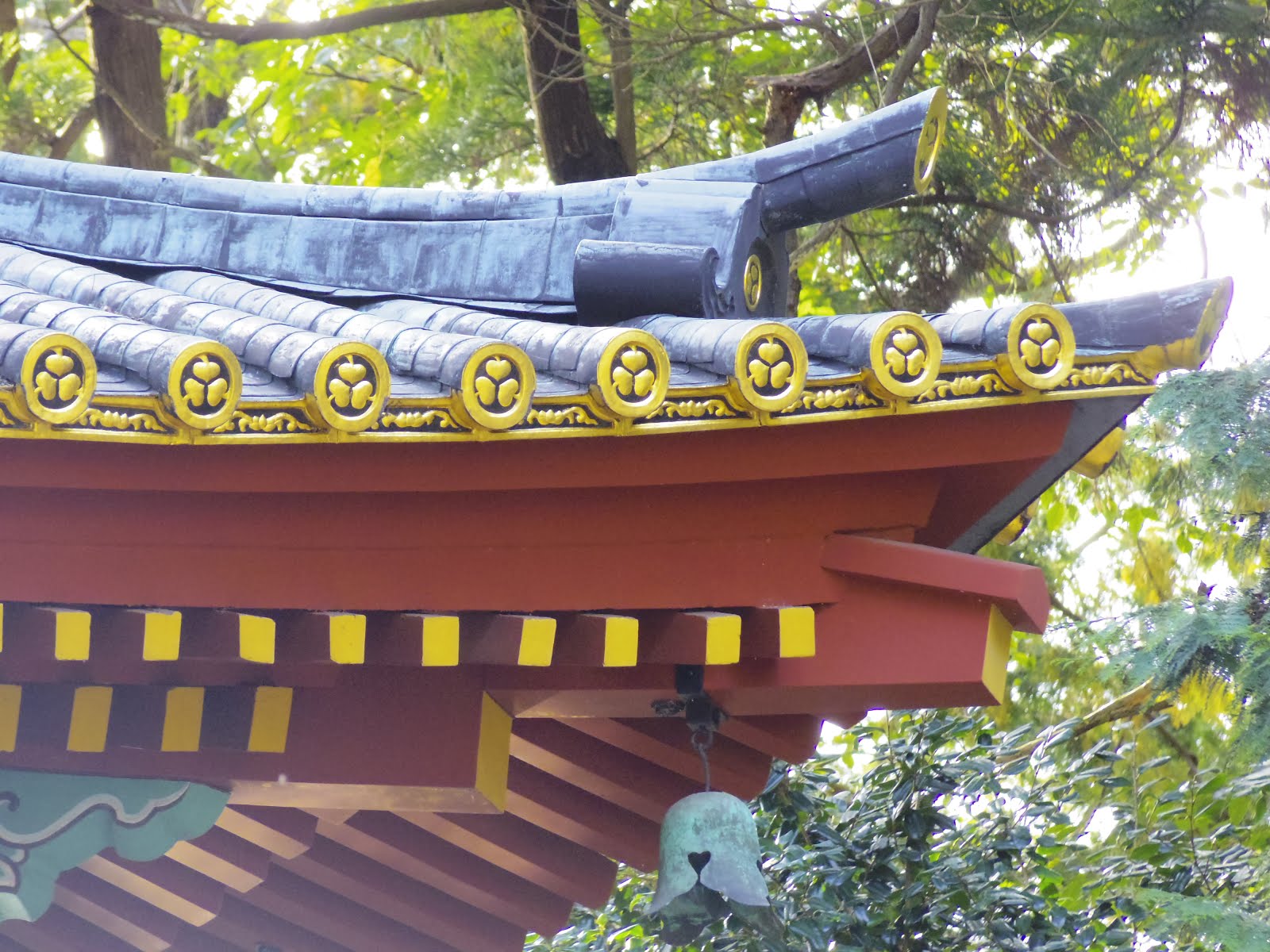
And oh what a surprise! A colourful gate at the end of a flight of stairs, and a stone gate and another colourful temple awaited our visit, while banners with the 3 chestnuts crest waved gently in the wind. There was hardly anyone in the cabin or on site. And it felt very solemn yet magical to be there.


And to my greatest pleasure, there were those roofs with wooden joinery that always made me exclaim at the ingenuity of the wood artisans and architects.


 So far the temples I have visited in Japan had very little decoration and were elegant and majestic in their simplicity, highlighting the lines and wood beams and grandeur. This temple was different and is more similar to those found in in South Korea.  I chanced upon an old man who seemed to be the retainer there, so I asked him about it. Luckily I understood bits and pieces and learned this was where the shogun Tokugawa Ieyasu (1543-1616) was enshrined. He was the shogun known for unifying Japan by starting the shogunate.


 So this is the Kunozan Toshogu shrine (久能山東照宮) apparently. Also enshrined here are also 2great military commanders, Toyotomi Hideyoshi and Oda Nobunaga, who I know from watching NHK Taiga dramas Gō: Hime-tachi no Sengoku (江〜姫たちの戦国〜)(thank you streaming sites and I love Ueno Juri上野 樹里 ).

As for the architecture of the site, no wonder it was used as model for other shrines. It displays fine craftmanship. Actually the style of the shrine was more buddhist than shinto.

From browsing the shrine site, there were a lot we did not see, such as the view of the ocean and maybe a view on Mount Fuji.
But nonetheless it was a beautiful sight and made ma happy to be near 400 year old lives that led a country to peace (a thought to all those lives lost). I can imagine how the ground is dear to the locals. It is made of their seat and blood literally. It reminded me how my christian upbringing mentioned not to bow to anyone but God, but the people here made these great figures as God, not because they were human but for what they have achieved and what their desire and aim where: peace, victory, perseverance.


The traits are deified and then humanized again in the form of stories that are transmitted over generations, and for which I am grateful as they spark the imaginations of talented story makers who come up with other stories in books, mangas (such as Noragami) and series.